Friday, March 29, 2013

Researching Small Farm Resource Centers


Since January of this year, ECHO Asia Impact Center staff, with major involvement from Dr. Ricky Bates (Penn State University), has been carrying out research for a case study entitled, The Small Farm Resource Center’s Current and Future Roles in Extension and Advisory Services in Southeast Asia.” Administered by MEAS (Modernizing Extension and Advisory Services) through the University of Illinois with major support from USAID, the study aims to document, evaluate and empower existing small farm resource centers as a useful research-extension tool in South and Southeast Asia operating outside the formal government/academic extension model.
Defined by ECHO’s first director, Dr. Martin Price, a Small Farm Resource Center (SFRC) is a research-extension tool that coordinates trials at a central site, as well on the fields of individual farmers, with the purpose of evaluating, within the community, ideas that have been proven elsewhere. The SFRC concept is that any new ideas, techniques, crops, or new varieties of a local crop may first be evaluated at the SFRC and promising ideas extended to local farmers with little risk. This adaptive research is done directly by the non-governmental agency (typically missions organizations and other small institutions) and local farmers and extended to the community.   
Related to this study, the overall objective for MEAS is to “define and disseminate good practice strategies and approaches to establishing efficient, effective and financially sustainable rural extension and advisory service systems in selected countries.”  With the support of MEAS, ECHO Asia staff and Dr. Bates have visited seven SFRCs across Southeast Asia (Thailand, Myanmar, Laos, Cambodia and the Philippines) and interviewed their community-based beneficiaries to attempt to determine whether the SFRC concept remains a viable means of conducting research and extension for smallholder farmers.
With the SFRC case study currently concluding, ECHO Asia and MEAS look forward to publishing the findings and sharing the results at the upcoming ECHO Asia Agriculture and Community Development Conference in Chiang Mai, Thailand in early October 2013 as well as at the ECHO Agriculture Conference in Ft. Myers, Florida in December 2013.  


Thursday, March 28, 2013

ECHO Asia and Aloha House Food Production and Agriculture Workshop


During March 5-7, ECHO Asia and Aloha House (http://www.alohahouse.org/) co-hosted the Philippines Agriculture Livelihood Workshop at the Aloha House Farm on the outskirts of Puerto Princesa, Palawan in the Philippines.  With 30 participants from across the Philippines, as well as one attendee who traveled from Laos, the group was exposed to numerous topics and hands-on activities including:
  • The principles of soil fertility
  • Green manure/cover crops
  • Small-scale livestock production: goats, hogs, chicken and fish
  • Foliar fertilizers
  • The production and use of bokashi for fertilizer and animal feed 
  • Perennial vegetables
  • Agroforestry
  • Intensive nursery production
  • An introduction to seed saving
A key ECHO Asia workshop activity, an introductory seed exchange event,  took place in which seed from many types of crops were shared between participants.

ECHO Asia is extremely grateful to Keith and Narcy Mikkelson and the Aloha House team for co-hosting this event.


Wednesday, March 6, 2013

Composting at the ECHO Asia Seed Bank

During the dry season there is no problem finding dry leaves to turn into compost.  With some cow manure and careful attention to proper aeration and moisture, within weeks the leaves are converted into compost for improvement of the soil in the seed production beds.

Tuesday, March 5, 2013

Exposure to Sustainable Agriculture for Chiang Mai International School Students

ECHO's main clientele is agriculture and community development workers seeking technical solutions to alleviate hunger and poverty.  However, you can never start too early in creating awareness regarding sustainable farming approaches.  This week, ECHO Asia and Partners Farm hosted a group of 45 8th grade science students from Chiang Mai International School for a morning of learning and hands on involvement.  They were able to learn the best way by getting their hands dirty related to basic soil science, appropriate technologies (e.g. treadle water pumps and biogas systems) and natural farming of pigs.


Thursday, January 31, 2013

100 Mile Walk

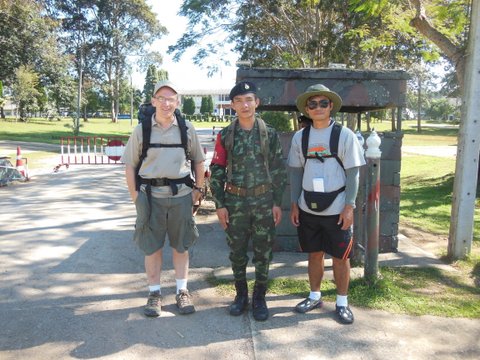
To raise awareness and support for ECHO Asia's work and to show solidarity for partnering agencies, in early December Rick Burnette (current ECHO Asia Director), Kimberly Duncan (ECHO Asia Intern) and Bunsak Tongdee (UHDP Director) walked 100 miles from the city of Chiang Mai to the ECHO Asia Seed Bank in the Mae Ai District of Chiang Mai.   Along the way, they were joined by Karl Frogner (UBI), Boonsong Thansritong (ECHO Asia) and Abram Bicksler (ECHO Asia's next director) as well as interns and volunteers from the ECHO Asia Seed Bank (Jen Smeage and friend Joel, Sam Bollenbacher, Ruth Tshin, Seth Morgan, Ben Burnette and William Burnette).

The walk took place over six days, beginning in Chiang Mai's urban environment, passing through fields and mountains, villages and small towns before ending at the seed bank not far from Thailand's border with Myanmar.  The entire trip took place on foot except for a 50-meter leg across the Ping River on a tiny boat in Chiang Dao (we took a wrong turn).

ECHO Asia is grateful for so many who supported this effort with contributions and encouragement.


Monday, January 21, 2013

Companion Planting at the Seed Bank

ECHO Asia intern, Jen Smeage, has spent the last several months evaluating companion planting at the seed bank.  According to the Wikipedia Companion planting entry (http://en.wikipedia.org/wiki/Companion_planting), this approach, whereby different crops are grown together, is intended to enable mixtures of select plants to assist each other in various ways, including with nutrient uptake, pest control and pollination.  Ultimately, this synergy is intended to increase crop production.  In addition to planting known compatible vegetables, various types of flowering plants are also planted to attract both beneficial insects, including pollinators such as bees and predators that eat pests such as aphids.  Some companion plants also serve as "trap crops," attracting pests away from vulnerable crops.  Some examples (University of Rhode Island; http://www.uri.edu/ce/factsheets/sheets/compplant.html) include:
  • Basil planted among tomatoes may repel tomato hornworms.
  • Marigolds, mint, thyme, or chamomile may repel cabbage moths.
  • Radishes make excellent trap crops for cucumber beetles among squash and cucumbers. Radishes also attract flea beetles when planted near cole crops.
Companion crops being evaluated at the seed bank include cosmos, calendula, hyssop, allysum, peppermint and marigold.  Jen says that the companion crops are definitely attracting lots of pollinating bees at the seed bank as well as lady bugs and lacewings that eat pests such as aphids.  And she sees trap crops, such as allysum, attracting aphids.  However, the current cool-dry season doesn't have as much insect pressure as the upcoming hot and rainy seasons.  So the coming months will offer a critical time to evaluate the overall effectiveness of the companion crops on in pest management at the seed bank. 

For persons who delight in pure, orderly, organized stands of crops, companion planting be too messy for them.  But for those who appreciate the positive effects that crop biodiversity might bring, not to mention patches of color in a sea of green, then companion planting should definitely be considered and evaluated.    

Thursday, January 3, 2013

Favorite Photos from 2012

Bunong Village, Cambodia

Northeast Cambodia

Senmonorom, Northeast Cambodia

ECHO Asia Cambodia Workshop

Sahibganj, India

Outside of Sahibganj, India

Sahibganj, India

ECHO Asia Seed Bank Team and Volunteers

Legumes growing in hill fields, Huay Pong Village, Thailand

Shwedagon Pagoda, Yangon, Myanmar

Shwedagon Pagoda, Yangon, Myanmar

ECHO Asia Myanmar Workshop

ECHO Asia Myanmar Workshop

Rice harvester, outside of Chiang Mai, Thailand

Street side gardening, Chiang Mai

Road to Fang, North Thailand

Roadside forest, North Thailand

North Thailand

Threshing rice, North Thailand

Rice fields near Mae Hong Son, Thailand

Doi Chiang Dao Mountain, North Thailand

Near Chiang Dao Cave, North Thailand

North Thailand

Mae Hong Son, Thailand