Sunday, May 6, 2012

Last Day of Training in Yangon by Ruth Tshin


Sack garden demonstration

We concluded the last day of our seed saving training in Yangon on Friday.  Covering topics of how to store seeds, the importance of germination, and information management, we continued discussions with MBC staff and farmers about linkages between seed saving and sustainable thinking.  Kimberly shared findings from her year-long study of managing pests in stored seeds and I put on my plant biology hat to talk about seeds as living potential and various ways to test seed quality through germination and planting out in soil.  Attendees continued to share their methods for saving and testing seeds with the group.

There is a hunger for practical, income-generating techniques here in Myanmar and we're privileged to be working with MBC as they continue to promote sustainable approaches with their farmers.  
One of our attendees stores onion seeds by letting a candle extinguish inside a closed container to create a light vacuum.

Another Day of Seed Saving Training by Ruth Tshin

Taking notes during our lively discussion
Putting seeds on the screen to dry after cleaning
Today we had more lively discussions as workshop attendees talked about economic barriers to sustainable practices in their communities. Kim taught the difference between annual and perennial plants, the effects of day-length on growth and details of pollination.  In the afternoon, I led a discussion about cleaning and drying seeds before our whole group pitched in to clean seeds from local tomatoes, pumpkin, ivy gourd and wax gourd.   So far, we've collected up to 15 varieties of seed to plant out at the seedbank, including  corn, bean, and pumpkin from Kayah State, and red sesbania from the Irrawaddy Delta area.
Kimberly teaching about day length and pollination
All hands on deck for the seed cleaning demonstration


Thursday, May 3, 2012

Seed Saving Training with Myanmar Baptist Convention


By Ruth Tshin, Volunteer ECHO Asia Consultant
Ruth and ECHO Asia intern, Kimberly Duncan, are currently in Yangon, Myanmar conducting a workshop on seed saving.

Burmese farmers are heavily dependent on chemicals to meet market demands and there is little knowledge of chemical-free food production.
Celebrating 200 years in 2013, Myanmar Baptist Convention (MBC) has over 2 million members from 18 different language groups throughout the country.  The Christian Social Service and Development Department (CSSDD) functions like a development organization for its members, many of whom are farmers struggling to maintain their livelihoods amidst high chemical and hybrid seed costs.  As Burma continues to open up to the global market and respond to pressure from China, MBC's farmers need innovative methods to supplement their income.

In their efforts to continue developing their staff and members' understanding of sustainable farming practices, MBC graciously invited ECHO Asia to teach seed saving techniques at their headquarters in Yangon this week.  Today, we (Ruth Tshin and Kimberly Duncan) started off a 3 day training session listening to the challenges experienced in their communities.  16 men and 2 women from 5 areas of Myanmar, representing Pwo Karen, Sgaw Karen, Asho Chin, Southern Shan and Mon conventions, were in attendance.  We shared our successes producing open-pollinated seeds using natural methods, as well as lessons learned from our failures from the past 3 years.  Between bouts of power outages, we had lively conversation about local vegetables and seed prices, and ended the first day by distributing seeds from our seedbank.

One of the Karen CSSDD staff talks about challenges in his area
Talking about plants after we gave out our seeds

Monday, April 9, 2012

At the ECHO Asia Seed Bank, various types of seed are at the end of
the production cycle, being cleaned and dried prior to packing and
storage. Such seed currently includes jack bean, sword bean,velvet bean, chickpea and grain amaranth.
Sword Bean

Velvet Bean
Chickpea

Grain Amaranth

Jack Bean

Permanent Raised Plant Beds Under Construction


The finest looking people at the ECHO Asia Seed Bank were chosen to
show off the permanent raised plant beds under construction in the
"Cambodia" plot (our production plots are named for various Asia
countries). Left to right: Abram, Kimberly, Lue, Faith, Jen, Wah,
Ruth, Marcia, Ricky and Asaeng.

Wednesday, March 28, 2012

Scenes from a Malto Community in Sahiganj, Jharkhand, east India

During the final day of the agriculture workshop (March 19-22, 2012) sponsored by ECHO, EFICOR, World Relief Canada and the Canadian Food Grains Bank, participants engaged in a field trip to an ethnic Malto community about 1.5 hours drive from the town of Sahibganj.  Welcomed by a song and dance committee, each visitor was treated to an extremely hospitable foot washing.  Afterward, the workshop delegation was led around the community to see impressive work related to small kitchen gardens, community forestry, improved livestock production, expansion of rice paddy land and sustainable upland farming. During the tour, we were also fortunate enough to encounter a vivid green and black chameleon who preferred to be left alone.

In such a semi-arid location, the livelihood successes of the Sona Malot community are obviously hard won.  Our group of visitors were able to see the value of integrated farming that included traditional crops such as pigeon pea, pearl millet, mustard (oil crop) and cowpea as well as recent innovations such as the expansion of rice paddy land.  


Tuesday, March 27, 2012

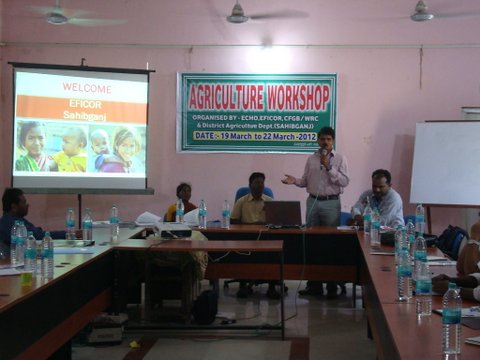
East India Agriculture Workshop

An agriculture workshop sponsored by ECHO, EFICOR and World Relief Canada was held in Sahibganj, Jharkhand in eastern India during March 19-22, 2012.  The event was attended by 26 persons representing five relief and development organizations from India’s east and northeastern regions.

In addition to technical presentations provided by local agricultural officials related to agroforestry, secondary agriculture and aquaculture, ECHO Asia Impact Center Director, Rick Burnette and ECHO Asia Research Consultant, Dr. Ricky Bates (professor of Horticulture at Penn State University), offered sessions related to moringa, green manure/cover crops, sustainable upland farming, the System of Rice Intensification (SRI) and urban/backyard agriculture. EFICOR staff and local community-based partners also shared case studies related to their agriculture livelihood work in the project’s Sahibganj focus area.

Besides an introduction to seed exchange in which crop seeds from northeast India and ECHO Asia were distributed, a following networking session enabled representatives from each organization to share experiences related to agriculture and community development.  Each group gave examples of efforts that have succeeded or have proven difficult to carry out. 

On the final day, participants traveled to ethnic Malto communities outside of Sahibganj to learn about EFICOR’s food security partnership with local families to promote small kitchen gardens, community forestry, conservation farming and improved livestock production.  After returning to Sahibganj that evening, the workshop closed with the distribution of certificates and a brief worship service.

ECHO Asia would like to express its gratitude to EFICOR for hosting the workshop as well as to World Relief Canada and the Canadian Food Grains Bank for their support towards the event.