
Wednesday, March 6, 2013
Composting at the ECHO Asia Seed Bank


Tuesday, March 5, 2013
Exposure to Sustainable Agriculture for Chiang Mai International School Students


Thursday, January 31, 2013
100 Mile Walk
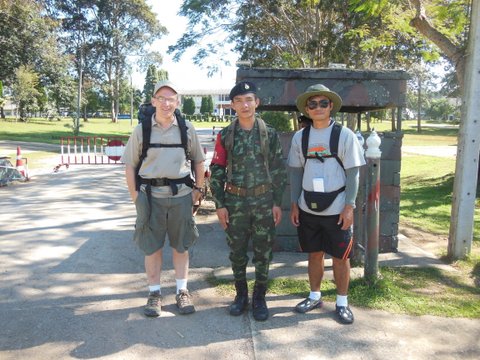
The walk took place over six days, beginning in Chiang Mai's urban environment, passing through fields and mountains, villages and small towns before ending at the seed bank not far from Thailand's border with Myanmar. The entire trip took place on foot except for a 50-meter leg across the Ping River on a tiny boat in Chiang Dao (we took a wrong turn).
ECHO Asia is grateful for so many who supported this effort with contributions and encouragement.


Monday, January 21, 2013
Companion Planting at the Seed Bank

- Basil planted among tomatoes may repel tomato hornworms.
- Marigolds, mint, thyme, or chamomile may repel cabbage moths.
- Radishes make excellent trap crops for cucumber beetles among squash and cucumbers. Radishes also attract flea beetles when planted near cole crops.

Companion crops being evaluated at the seed bank
include cosmos, calendula, hyssop, allysum, peppermint and marigold.
Jen says that the companion crops are definitely attracting lots of
pollinating bees at the seed bank as well as lady bugs and lacewings
that eat pests such as aphids. And she sees trap crops, such as
allysum, attracting aphids. However, the current cool-dry season
doesn't have as much insect pressure as the upcoming hot and rainy
seasons. So the coming months will offer a critical time to evaluate
the overall effectiveness of the companion crops on in pest management at
the seed bank.
For persons who delight in pure, orderly,
organized stands of crops, companion planting be too messy for them.
But for those who appreciate the positive effects that crop
biodiversity might bring, not to mention patches of color in a sea of
green, then companion planting should definitely be considered and
evaluated.
Thursday, January 3, 2013
Favorite Photos from 2012
 |
| Bunong Village, Cambodia |
 |
| Northeast Cambodia |
 |
| Senmonorom, Northeast Cambodia |
 |
| ECHO Asia Cambodia Workshop |
 |
| Sahibganj, India |
 |
| Outside of Sahibganj, India |
 |
| Sahibganj, India |
 |
| ECHO Asia Seed Bank Team and Volunteers |
 |
| Legumes growing in hill fields, Huay Pong Village, Thailand |
 |
| Shwedagon Pagoda, Yangon, Myanmar |
 |
| Shwedagon Pagoda, Yangon, Myanmar |
 |
| ECHO Asia Myanmar Workshop |
 |
| ECHO Asia Myanmar Workshop |
 |
| Rice harvester, outside of Chiang Mai, Thailand |
 |
| Street side gardening, Chiang Mai |
 |
| Road to Fang, North Thailand |
 |
| Roadside forest, North Thailand |
 |
| North Thailand |
 |
| Threshing rice, North Thailand |
 |
| Rice fields near Mae Hong Son, Thailand |
 |
| Doi Chiang Dao Mountain, North Thailand |
 |
| Near Chiang Dao Cave, North Thailand |
 |
| North Thailand |
 |
| Mae Hong Son, Thailand |
Thursday, December 20, 2012
A Banana Multiplication Success Story
 |
| ECHO Asia technical advisor, Dr. Abram Bicksler, carrying out a similar banana multiplication test (results may vary according to banana varieties and locations). |
At the 2011 ECHO
Asia Conference we asked the delegates to share stories describing successful
uses of ECHO's information and resources. The following is one in a series of
posts containing these success stories.
ECHO's activities, from publications to conferences to
seed distribution, all have one goal: getting resources into the hands of
workers on the field so that we can indeed “honor God through sustainable
hunger solutions.” For long-time members of the ECHO network all these
disparate activities really seem unified. Buzz Maxey, of CAMA Services, shared
a few comments with us, illustrating how he has utilized a number of different
ECHO information and resources over the years:
“First, banana propagation
gleaned from EDN
[66]. A lot of my efforts and trials have been a fiasco but I was
successful in this one: peel off 3 layers of the banana stalk, cut off the
leaves, bend stalk over in [the shape of] a number 7. Drive a stake through the
stalk at knee level, dig out a bit at the base of the plant, refill with
compost, and in a few weeks many pups will sprout.
Second, chaya, moringa,
papaya, loquat, and erethrina have all grown well. One farmer has sweet
papaya—50 plants—at 5000 ft. elevation and his 75 head of cattle are eating
chaya.
Third, I have attended four
ECHO conferences and benefited every time. I have been blessed to be with
people of like mind who are impacting the world's poor.” --Buzz
Maxey, October 2011
Buzz Maxey was able to learn about banana multiplication
from an EDN, receive samples of useful species from the ECHO seedbank, and
share encouragement and information at four ECHO conferences. This is just one
example of how ECHO's multiple activities serve the ultimate goal of serving
the poor through sustainable agricultural solutions.
If you'd like more information about rapid banana
multiplication see EDN
66, which Mr. Maxey referenced, and EDN
99, which demonstrates a slightly different technique. Both are available
at ECHOcommunity.org.
Monday, December 3, 2012
Seed Production at Tung Kwang Tong Community


Tung Kwang Tong (Field of the Golden Deer) Community, also in Mae Ai, is predominantly ethnic Palaung. Despite limited access to fields for rice and cash crop production, they tend impressive kitchen gardens.

ECHO Asia recently worked out an arrangement with community members to grow select crops, such as tomato and long bean, for the seed bank. This arrangement provides supplemental income for the participating gardeners while improving the seed bank's access to more types of seed.


Subscribe to:
Posts (Atom)


 Posts
Posts


